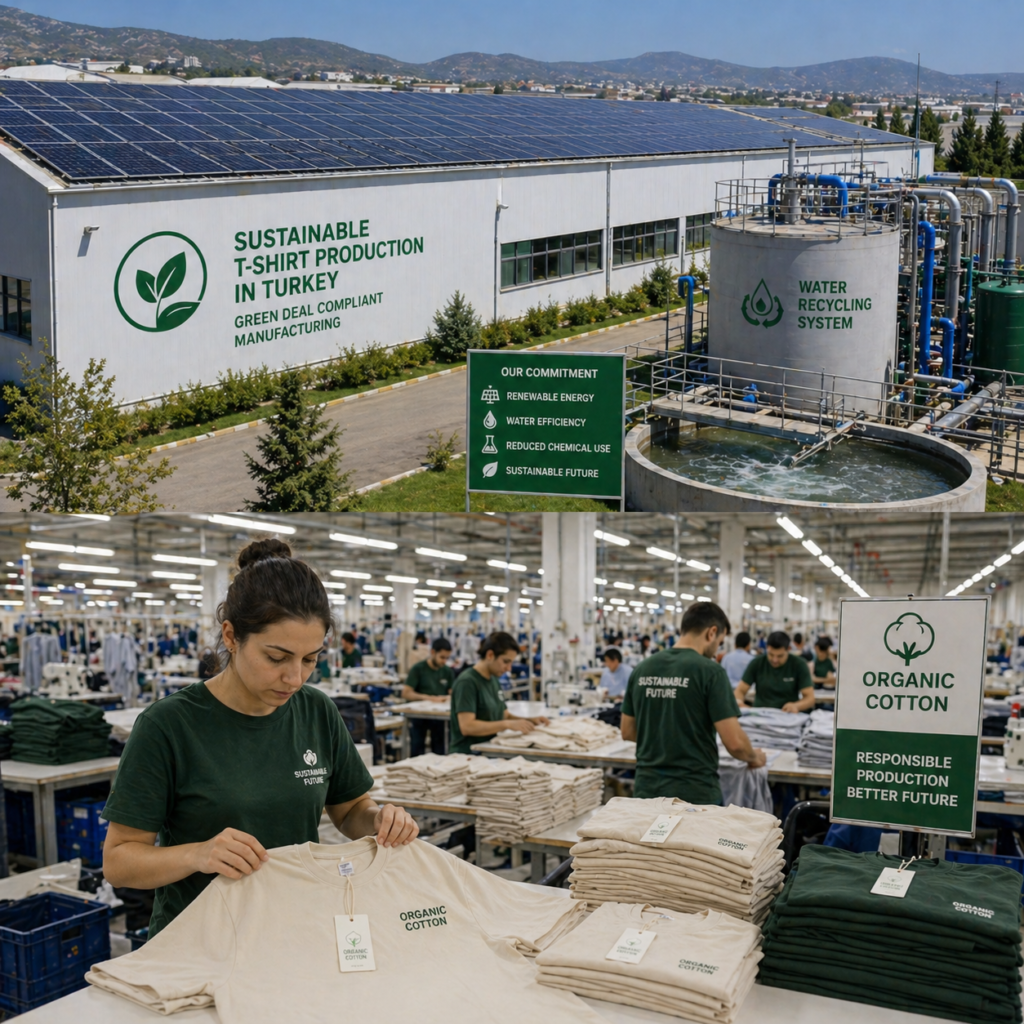
Your t-shirt brand wants to grow. You need quality, speed, and fair prices. However, a new factor now dominates smart sourcing decisions: sustainability. European consumers demand eco-friendly garments. Regulators enforce strict rules. Therefore, your manufacturing partner must align with the Turkey Green Deal Action Plan for the Textile & Apparel Sector. This framework helps Turkish producers reduce emissions, save water, and use clean energy. Consequently, your t-shirt brand gains a powerful marketing story and regulatory safety. This guide explains exactly how to leverage this green transformation.
What Is Turkey’s Green Deal Action Plan?
The Turkey Green Deal Action Plan – Textile & Apparel Working Group was launched to harmonize Turkish manufacturing with EU environmental standards. It focuses on decarbonization, circular economy, sustainable raw materials, water and chemical management, and green financing. Turkish factories that participate undergo regular audits. They invest in solar energy, water recycling, waste reduction, and chemical substitution. For example, a Turkish clothing manufacturer compliant with the plan might reuse 80% of its dyeing water or power cutting machines with rooftop solar panels. As a result, your t-shirts have a smaller carbon footprint.
Moreover, the Working Group organizes training and knowledge sharing. Manufacturers learn best practices from each other. This collective effort accelerates the entire sector’s green transition. Therefore, choosing a Green Deal-aligned partner means supporting continuous improvement.
Why T-Shirt Brands Should Care
You might think sustainability only matters for large corporations. That is no longer true. Small and medium streetwear brands face pressure from three directions. First, consumers research brand practices. They avoid greenwashers and support transparent labels. Second, EU regulations like the Corporate Sustainability Reporting Directive (CSRD) apply to any brand selling in Europe, regardless of size. Third, retailers and marketplaces increasingly demand proof of ethical and environmental compliance. Consequently, ignoring the Green Deal puts your t-shirt brand at risk.
On the other hand, embracing it creates opportunities. Sustainable t-shirts command premium prices. They attract loyal customers. They also simplify cross-border sales. Therefore, integrating the Turkey Green Deal Action Plan – Textile & Apparel Sector into your sourcing strategy is smart business.
Eco-Friendly Fabrics for T-Shirts
Your t-shirt’s environmental impact starts with the fiber. Conventional cotton uses massive amounts of water and pesticides. Fortunately, better options exist. Organic cotton is grown without synthetic chemicals. It uses up to 91% less water than conventional cotton. Turkey is a major producer of certified organic cotton. A Turkish clothing manufacturer can source it locally, reducing transport emissions.
Recycled cotton is another excellent choice. It comes from post-industrial or post-consumer waste. It avoids new farming and dyeing. However, recycled cotton fibers are shorter, so often blended with organic or conventional cotton. A 50/50 blend works well for durable t-shirts.
Hemp and Tencel (lyocell) are innovative alternatives. Hemp grows quickly with little water and no pesticides. Tencel uses a closed-loop process that recycles solvents. Both produce soft, breathable fabrics perfect for t-shirts. Turkish manufacturers increasingly offer these materials as part of their Green Deal commitments.
Look for certifications: GOTS (Global Organic Textile Standard), OEKO-TEX Standard 100, and BCI (Better Cotton Initiative). These provide third-party verification. The Turkey Green Deal Action Plan Textile Apparel Working Group encourages widespread certification.
Green Dyeing and Finishing
Conventional textile dyeing is notoriously polluting. It uses large amounts of water, energy, and chemicals. However, new technologies are changing this. For example, foam dyeing applies dye as a foam rather than a liquid bath. It reduces water use by up to 50%. Air-dyeing uses compressed air instead of water to fix dyes to fabric. Some Turkish factories have adopted these methods.
Digital printing on fabric eliminates screen cleaning waste. It also allows on-demand production, reducing overstock. Reactive dyes with high fixation rates mean less dye washed off into wastewater. A Green Deal-aligned Turkish clothing manufacturer will treat all wastewater before discharge. Some even recover and reuse water multiple times.
Furthermore, many Turkish textile mills now use renewable energy. Solar panels on factory roofs power looms and dyeing machines. This reduces the carbon footprint per t-shirt significantly. Ask your potential partner about their energy mix.
Circular Production and Waste Reduction
Sustainability does not stop at dyeing. Cutting and sewing produce fabric scraps. In a circular model, these scraps are collected and recycled into new yarn. Some Turkish manufacturers have partnerships with recycling facilities. Others use zero-waste pattern cutting to minimize scrap from the start.
Defective t-shirts can also be recycled. Rather than landfilling, they are shredded and spun into new fiber. This closed-loop approach keeps materials in use. It also reduces raw material costs over time. Therefore, circular production is both environmentally and economically smart.
The Turkey Green Deal Action Plan promotes circular economy principles. Participating manufacturers report on waste diversion rates and recycling partnerships. As a brand, you can include these metrics in your sustainability communications.
Packaging and Logistics Under the Green Deal
Your t-shirt’s journey does not end at the factory gate. Packaging and shipping also impact the environment. Single-use plastic poly bags are a problem. Fortunately, alternatives exist. Compostable bags made from cornstarch break down naturally. Recycled plastic bags give waste a second life. Some brands use paper wraps or reusable cotton bags. Your manufacturer can source these options.
Turkey’s proximity to Europe is a huge logistical advantage. Trucks can deliver t-shirts to most EU countries in 3-5 days. This is much faster and lower-emission than sea or air freight from Asia. Consequently, your supply chain’s carbon footprint shrinks naturally.
To further reduce impact, consolidate shipments. Order larger quantities less frequently. Ask your Turkish clothing manufacturer about carbon offset programs. Some factories invest in reforestation or renewable energy projects to compensate for remaining emissions.
Certifications and Transparency for Your Brand
Marketing sustainable t-shirts requires credible proof. Greenwashing damages trust quickly. Therefore, collect and share certifications. GOTS certification ensures organic status, ethical labor, and environmental management across the entire supply chain. OEKO-TEX Made in Green provides traceability and worker safety data. The Turkey Green Deal Action Plan – Textile & Apparel Sector includes a monitoring framework. Manufacturers share verified data on energy, water, waste, and chemicals. Request this data for your marketing claims and regulatory filings.
EU regulators are introducing Digital Product Passports (DPPs). These will contain detailed environmental and material information for each garment. Early adoption positions your t-shirt brand as a leader. Your Green Deal-aligned manufacturer can help populate DPPs with accurate data.
Actionable Steps for Your T-Shirt Brand
Ready to start your sustainable journey? Follow these steps:
First, research Turkish clothing manufacturers that openly participate in the Green Deal Action Plan. Check their websites for sustainability reports and certifications. Second, request an initial meeting. Ask specific questions about their water recycling, energy sources, and waste management. Third, order fabric swatches and sample t-shirts made from organic cotton, recycled cotton, or Tencel. Test the feel, durability, and shrinkage.
Fourth, request wash tests for prints or dyes. Ensure colors stay vibrant and fabrics do not pill. Fifth, negotiate packaging: compostable poly bags or recycled options. Sixth, collect all documentation: GOTS certificates, OEKO-TEX reports, and Green Deal compliance data. Use these in your marketing and on your product pages.
Conclusion
The Turkey Green Deal Action Plan for the Textile & Apparel Sector is not a bureaucratic exercise. It is a practical roadmap to cleaner, more responsible t-shirt production. By partnering with a compliant Turkish clothing manufacturer, your streetwear brand meets consumer expectations and regulatory demands. You gain authentic sustainability stories. You reduce long-term risks. And you contribute to a healthier planet. Start your green t-shirt journey today.