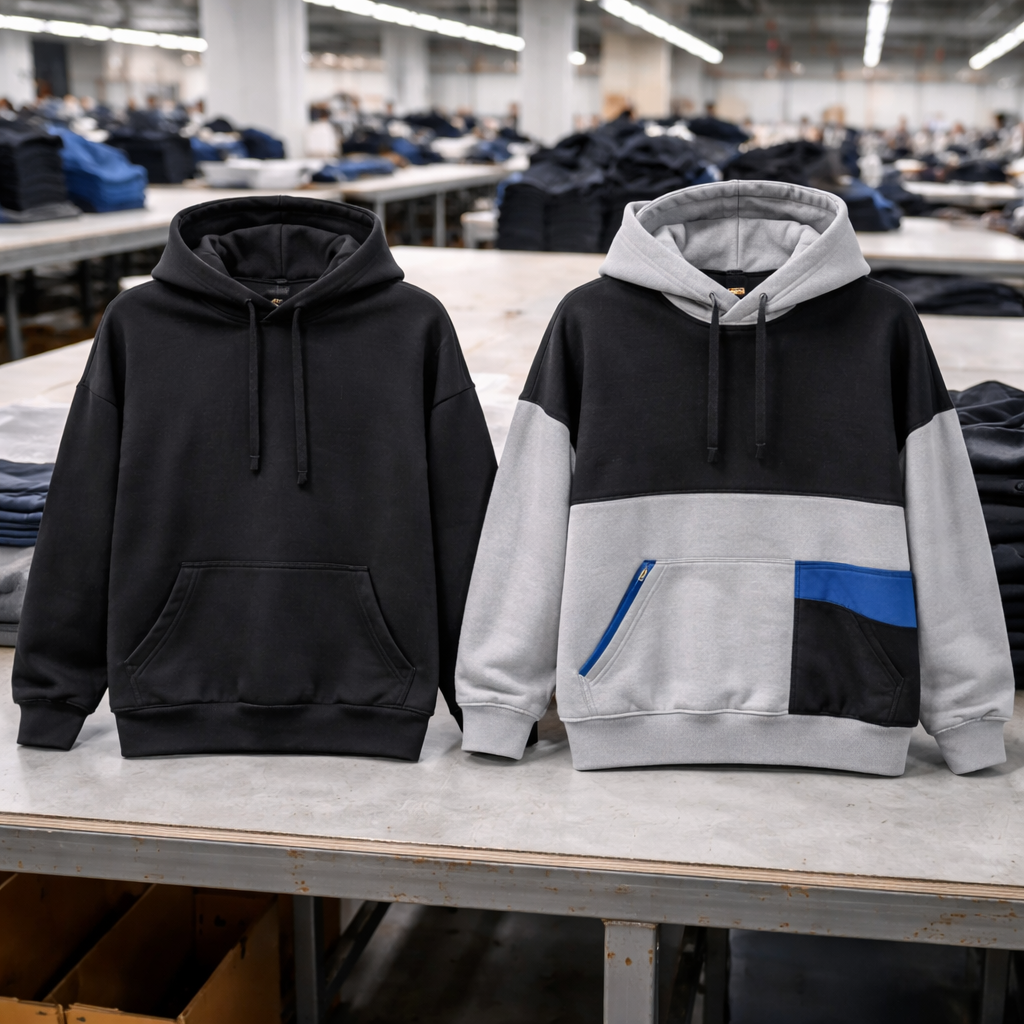
Every streetwear founder faces a fundamental decision early in their journey. It’s a choice that shapes your brand’s identity, your profit margins, your production timelines, and your ability to stand out in a crowded market. Should you print on blank, ready-made garments? Or should you invest in full cut-and-sew production, creating custom patterns and silhouettes from scratch? There is no universal right answer. The best choice depends on your brand’s vision, your budget, your volume, and your long-term goals. This guide breaks down both paths, revealing the hidden costs and benefits of each. By the end, you’ll know exactly which manufacturing method aligns with your streetwear brand’s strategy, especially when working with a Turkish clothing manufacturer.
The difference between blanks and cut-and-sew is simple in theory but complex in practice. Blanks are pre-manufactured garments—t-shirts, hoodies, sweatshirts—that you purchase from a supplier and then print or embellish with your designs. Cut-and-sew means you start with raw fabric, create your own patterns, and produce garments that are uniquely yours in fit, construction, and details. Many iconic streetwear brands began with blanks, then transitioned to cut-and-sew as they grew. Others launched with custom silhouettes from day one. Understanding the trade-offs will save you from costly missteps.
The Blank Path: Speed, Simplicity, and Lower Risk
For most new streetwear brands, blanks are the logical starting point. Why? Because they remove the most complex and capital-intensive variables from your production equation. When you order blanks from a reliable Turkish clothing manufacturer or blank supplier, you know exactly what you’re getting. The fabric weight, the fit, the construction quality—all are standardized. Your only variable is the print or embroidery you add.
The advantages of blanks are compelling. Lower minimum order quantities are the biggest benefit. You can order 50 pieces of a specific hoodie blank, print 50 units of a new design, and test the market. If it sells out, you reorder. If it doesn’t, you’re not stuck with hundreds of unsold custom-made garments. This test-and-learn approach dramatically reduces financial risk. Faster turnaround is another advantage. Blanks are typically in stock. Your manufacturer can ship them immediately for printing. From order to delivery, you might be looking at 4-6 weeks, compared to 10-14 weeks for cut-and-sew. Lower upfront investment means you can launch your brand with a few thousand euros instead of tens of thousands.
However, blanks come with significant limitations. Lack of uniqueness is the biggest. If you’re printing on a popular blank (like a Gildan or a Russell Athletic), other brands are using the exact same canvas. Your fit is their fit. Your hoodie feels like their hoodie. In streetwear, where differentiation is everything, this can be a problem. Fit constraints mean you’re limited to the silhouettes offered by blank suppliers. Want an extra-long t-shirt with dropped shoulders and a curved hem? A standard blank won’t deliver that. Quality variability exists across blank brands. Some are exceptional; many are mediocre. Your brand’s reputation becomes tied to a blank you don’t control.
The Cut-and-Sew Path: Total Control and True Originality
Cut-and-sew manufacturing is the holy grail for streetwear brands that want to create something truly distinctive. You design the pattern. You select the fabric from a mill. You specify every detail: the pocket shape, the ribbing density, the seam construction, the label placement. The result is a garment that cannot be copied. It fits your vision perfectly. It feels unique in hand.
The advantages of cut-and-sew are substantial. Complete design freedom means you can create any silhouette you imagine. Oversized boxy hoodies with dropped armholes? Yes. Cropped t-shirts with raw hems? Absolutely. Tracksuits with custom piping and zipper pulls? Done. Your creativity is the only limit. Superior quality control comes from specifying every component. You choose the fabric weight, the thread type, the interlining. A reputable Turkish clothing manufacturer will help you source premium materials that align with your brand’s quality standards. Brand identity and loyalty grow when customers recognize your unique fit. They can’t find your hoodie anywhere else. That scarcity and distinctiveness build cult followings.
However, cut-and-sew demands more from you. Higher minimum order quantities are the biggest barrier. Most cut-and-sew manufacturers require 200-500 pieces per style and color to make production economically viable. This means a larger upfront investment and higher inventory risk. Longer lead times are typical. From pattern making, grading, and sampling to fabric sourcing, cutting, sewing, and finishing, expect 10-14 weeks from design to delivery. More complexity and more things that can go wrong mean you need to be more involved. Pattern errors, fabric shrinkage mismatches, and construction flaws can derail your timeline. You need a patient, experienced clothing manufacturer in Turkey to guide you.
The Hybrid Approach: Smart Streetwear Strategy
Many successful streetwear brands use a hybrid model, especially in their first two years. They launch with premium blanks for their core, high-volume items (like basic logo t-shirts and hoodies) to establish cash flow and test designs. Simultaneously, they develop one or two cut-and-sew “hero” pieces—a signature jacket, a custom tracksuit, a unique hoodie silhouette—that define their brand identity. As sales grow and capital accumulates, they gradually shift more of their line to cut-and-sew.
This approach balances risk and ambition. The blank-based items provide reliable margins and fast turnaround for bestsellers. The cut-and-sew pieces create differentiation and justify premium pricing. Your customers get the familiar basics they love and the exclusive pieces they crave. When you work with a Turkish clothing manufacturer, ask if they offer both services. Many do. They can supply high-quality blanks from their own production lines or partner mills, and also handle full cut-and-sew for your custom designs. This one-stop solution simplifies logistics and builds a deeper partnership.
Cost Comparison: What You Actually Pay
Let’s talk numbers, because cost is often the deciding factor. For a premium blank hoodie (400 GSM, 80/20 cotton-polyester, screen printed with a 2-color design), your all-in cost from a Turkish supplier might be €18-25 per unit including printing, depending on quantity (100-500 pieces). For a comparable cut-and-sew hoodie with custom fit, the same fabric quality, and similar printing, your cost might be €25-35 per unit at 300 pieces. The cut-and-sew version is more expensive, but not dramatically so. The real difference is the upfront sampling and pattern making fees (€500-1500) and the higher MOQ.
However, the perceived value difference can be significant. A customer might pay €60 for a blank-based hoodie and €90 for a cut-and-sew hoodie with a unique fit. Your margin per unit could actually be higher on the cut-and-sew piece because you can command a premium price. The math depends on your brand’s positioning. If you’re competing on price, blanks are safer. If you’re competing on exclusivity and design, cut-and-sew is the path.
Decision Framework: Which Path Is Right for You?
Answer these five questions honestly to guide your choice:
- What is your launch budget? Under €5000? Start with blanks. Over €15,000? Consider cut-and-sew for at least one style.
- How unique is your fit vision? Standard oversized or regular fit? Blanks work. Cropped, elongated, asymmetric, or boxy beyond standard? You need cut-and-sew.
- What is your minimum order confidence? Can you sell 200 pieces of a single style? If yes, cut-and-sew is feasible. If you need 50-piece runs, stick to blanks.
- What is your brand positioning? Mid-market streetwear? Blanks can work if you choose premium blanks. High-end or niche? Cut-and-sew is almost essential.
- How patient is your timeline? Need products in 6 weeks? Blanks. Can wait 12-14 weeks for a perfect, unique garment? Cut-and-sew.
Working with Turkish Manufacturers for Both Options
Turkey is an exceptional sourcing destination for both blanks and cut-and-sew. Turkish clothing manufacturers produce some of the world’s best cotton-heavy fleece and ringspun cotton blanks. You’ll find options ranging from budget-friendly to luxury. For cut-and-sew, Turkey’s vertically integrated textile industry is a dream. You can source fabric from mills, trims from local suppliers, and complete production all within a manageable radius. The proximity to Europe means faster sampling and shipping. The quality-to-price ratio beats most alternatives.
When evaluating a Turkish clothing manufacturer, ask specific questions. For blanks: “Which blank styles do you stock? Can I order pre-production samples? What is your printing capacity and lead time?” For cut-and-sew: “What is your pattern making and grading fee? How many sampling rounds do you include? What are your MOQs for custom fabrics?” A transparent manufacturer will answer clearly.
Conclusion: Start Smart, Scale Strategically
There is no shame in launching with blanks. Many of today’s most respected streetwear brands did exactly that. The key is to be intentional. Choose the highest quality blanks your budget allows. Invest in exceptional printing. Build a brand story that transcends the canvas. Then, as you grow, introduce cut-and-sew pieces that showcase your unique vision. Your Turkish clothing manufacturer can grow with you, supporting both phases of your journey. The streetwear market rewards authenticity, consistency, and quality—not how you started, but how you evolve. Make the choice that aligns with your resources and your ambition. Then get to work. Your brand is waiting.