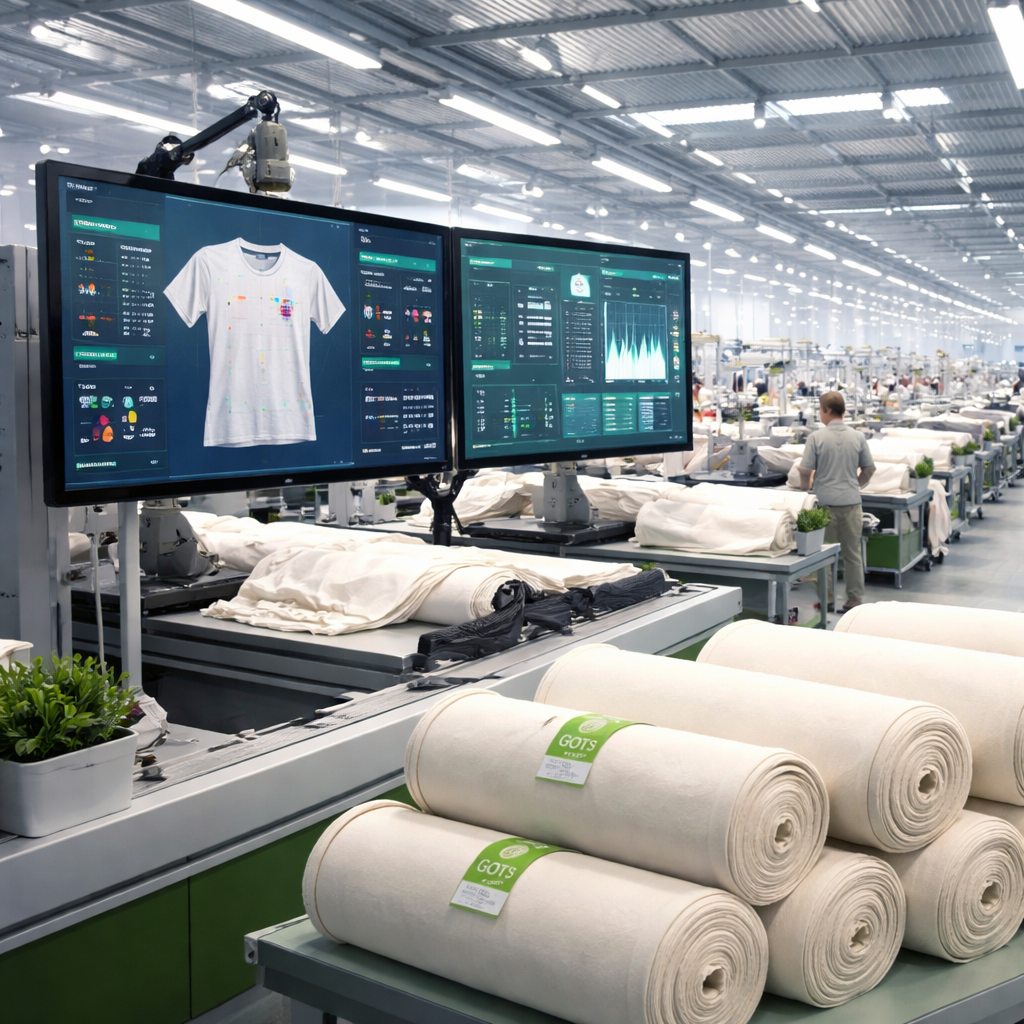
Something extraordinary is happening in Turkey’s textile sector. It’s not just about another trade fair or a new collection launch. It’s a fundamental reinvention of an entire industry. Istanbul Fashion Connection (IFCO) recently wrapped its ninth edition, drawing nearly 30,000 professional visitors from 134 countries . But beyond the impressive numbers, the event revealed a powerful strategic shift: Turkey is no longer competing on volume or low cost. Instead, a new national strategy is taking shape—one that positions Turkish clothing manufacturers at the intersection of two unstoppable forces: digital intelligence and green responsibility. This “Twin Transition” is rewriting the rules of global apparel sourcing, and forward-thinking European brands are taking notice.
The concept of a “Twin Transition” might sound like industry jargon, but its implications are profoundly practical. Launched by the Istanbul Apparel Exporters’ Association (İHKİB) with support from the Istanbul Development Agency, this 12-month project is designed to help manufacturers build capability across both green transformation and digitalization simultaneously . The logic is simple yet powerful: sustainability and efficiency are not competing priorities but complementary forces. A factory that reduces energy waste also lowers costs. A production line that uses AI to detect defects also reduces material waste. A clothing manufacturer in Turkey that embraces both digital tools and eco-friendly practices becomes precisely the partner European brands need to navigate tightening regulations and demanding consumers.
The Digital Half: AI and Automation Reshape Production
Walk through a modern Turkish textile facility today, and you’ll witness a technological revolution. Artificial intelligence is no longer a futuristic concept; it’s an everyday tool delivering measurable results. Take Viquins, a Turkish company specializing in AI-supported visual quality control. Their systems, powered by deep learning algorithms and high-resolution cameras, can detect sewing defects, color variations, and surface imperfections with up to 98% accuracy . For manufacturers, this translates to a dramatic reduction in waste rates—from 15% down to as low as 3%—and a 70% decrease in the need for manual inspection . When your Turkish clothing manufacturer deploys such technology, your brand benefits from consistent quality and fewer costly returns.
The innovation doesn’t stop at quality control. Turkish R&D firms are developing breakthrough solutions for every stage of production. Rightyon, a Turkish SME, has patented a “Next Generation Cutting Room Platform” called Righttex that revolutionizes fabric handling. The system enables autonomous labelling during spreading, eliminates marker paper entirely, and reduces production steps from seven to three. The result? Part-based labor costs dropped by 40% in industrial applications, with over 100 million labels successfully applied across 40+ fabric types . Major Turkish manufacturers like Yeşim Tekstil and LC Waikiki have already adopted this technology, proving that innovation isn’t just for niche players—it’s becoming standard practice among leading Turkish clothing manufacturers .
Even energy-intensive processes like dyeing and yarn production are getting smarter. Cormind, a domestic technology company, offers AI-powered factory operating systems that enable textile plants to increase production efficiency by 10% to 40% within the first year, while achieving average energy savings of approximately 15% . Their “Plug-and-Run” platform can be installed in just one day, giving manufacturers instant visibility into production metrics and energy consumption . For European brands concerned about carbon footprints, partnering with a clothing manufacturer in Turkey that uses such systems means verifiable reductions in environmental impact—without sacrificing profitability.
The Green Half: Sustainability as Competitive Advantage
Turkey’s green transformation is equally ambitious. The EU’s Green Deal and upcoming 2027 traceability mandates are reshaping the compliance landscape. European consumers now demand proof: 49% prioritize verifiable product origins when making purchasing decisions . Turkish manufacturers are responding with serious investment. Modern facilities feature water recycling systems, solar energy installations, and certified sustainable material sourcing. The “Twin Transition” project specifically helps suppliers meet these demands through structured transformation roadmaps, digital and sustainability assessments, and mentoring for EU funding schemes .
This commitment extends beyond factory walls. At IFCO, exhibitors showcased advanced digital infrastructures including AI-generated modeling and RFID-integrated inventory systems—tools that enable full supply chain transparency . When your Turkish clothing manufacturer can provide Digital Product Passport (DPP) readiness, you’re not just meeting compliance; you’re building a marketing advantage. You can credibly communicate lower carbon footprints, ethical labor practices, and traceable materials to conscious consumers.
The Nearshoring Advantage Amplified
Turkey’s geographic position has always been an asset, but the Twin Transition makes it even more powerful. Being within a four-hour flight of 1.4 billion people across Europe, Asia, and Africa is valuable. However, as Erçin Temel, CEO of Cormind, notes: “To capture the expected momentum after 2026 and move into the world’s top three, we must maximise efficiency. Using traditional methods, it is mathematically very difficult to raise our global market share beyond 5%. When textile manufacturers process every piece of data on their production lines and reduce their costs, they will become the strongest contributors to this national objective” .
This combination of proximity and technological sophistication creates an unbeatable value proposition. A Turkish clothing manufacturer can offer European brands the speed of nearshoring—with lead times measured in days rather than weeks—plus the quality and transparency that digital tools enable. You can visit factories easily, collaborate on samples in real-time, and scale production with confidence. The old trade-offs between cost, speed, and ethics are dissolving.
Real-World Results: Technology in Action
The evidence is accumulating. Serkon Makina, one of Turkey’s leading manufacturers of automated fabric spreading and CNC cutting systems, reports that their highly automated lines increase laying and cutting speeds by 30-50% while reducing labor requirements by up to 40%. Fabric waste rates decrease by 3-7%, and energy consumption drops by 15-20% with new-generation systems . These aren’t hypothetical gains; they’re measurable improvements that directly impact your bottom line.
Meanwhile, at the fiber level, Turkish companies like Zirve Tekstil are setting new benchmarks for quality. By combining the best technologies from global leaders Trützschler, Toyota, and Murata, they’ve created a production setup that delivers outstanding yarn quality recognized worldwide. The mill produces 18.5 tons of premium combed ring yarn daily, using locally grown cotton with greater fiber variability, yet consistently meets stringent international standards . This commitment to excellence, enabled by smart technology choices, ensures that Turkish clothing manufacturers can deliver the consistency European brands demand.
What This Means for Your Brand
For European fashion brands evaluating sourcing options, Turkey’s Twin Transition offers a clear pathway. The industry is no longer competing solely on price; it’s competing on intelligence, sustainability, and partnership. Manufacturers are investing in the tools and certifications that matter: GOTS, Oeko-Tex, AI-powered quality control, and transparent data reporting.
When you partner with a forward-thinking Turkish clothing manufacturer, you gain access to:
- Verified sustainability data for marketing claims
- Consistent quality through AI-driven inspection
- Faster turnaround from integrated digital systems
- Lower risk of defects and returns
- Transparent supply chains meeting EU standards
Conclusion: The New Standard in Apparel Sourcing
The Twin Transition is more than a government initiative; it’s a fundamental repositioning of Turkish apparel on the global stage. By embracing both digital innovation and green responsibility, Turkish clothing manufacturers are building the factories of the future today. For brands seeking a partner that combines proximity, quality, and technological excellence, Turkey has never been more compelling.
As Mustafa Paşahan, Vice President of İHKİB, states: “Türkiye’s apparel sector has long been a strategic pillar of our export economy. With this project, we aim to strengthen the industry’s existing advantages by accelerating both green and digital transformation” . The message is clear: the Turkish textile industry is not just adapting to the future—it’s actively building it. And for European brands, that future is filled with opportunity.